AZ-305 - Microsoft Certified: Azure Solutions Architect Expert - I passed it, also what is Azure HorizonDB 🤣
Over the weekend I passed Microsoft Certified: Azure Solutions Architect Expert exam 😊
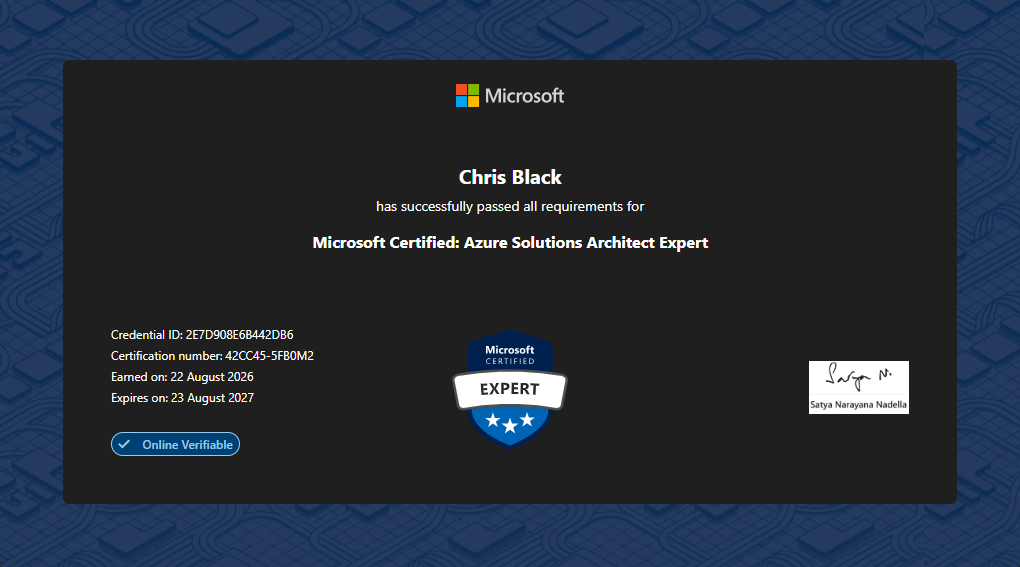
I have not done one of those in a while 🤣 and it was totally different experience since now I was able to sit AZ-305 in the comfort of my house.
I wanted to share my experience with you 😊
How I prepared for AZ-305
I do not think I am going to be showing any revelations here 🤣
Luckily I had access to Pluralsight so I went through all their courses there:
Pluralsight - Microsoft Certified: Azure Solutions Architect Expert (AZ-305)
They have 5 or so courses with labs so it was a great starting point, as it has been a while since I have done my prerequisite exam AZ-104 (I have done it when it was still AZ-100 I think 🤣)
Then I went through Microsoft free courses - Microsoft Certified: Azure Solutions Architect Expert course
After doing all this, I went a lot on Microsoft Learn and dug deeper into the topics I felt less confident about.
Then I took a lot of practice tests that you can do on Pluralsight and Microsoft Learn, also through both Pluralsight and Microsoft Learn course they give vou a few sample questions and those are great starting points too 😊
How to prepare for an online Pearson VUE exam
This one was pretty new to me, I was afraid that my work space is too cluttered as I have my home desktop PC and my work laptop in the same office and it would never “fly”. Then I started digging at the requirements and it was not that bad 🤣
The biggest gotcha was the fact that you are not allowed to use any headsets or earphones, you have to have a speaker!
So I bought this piece of beauty as they do not even allow bluetooth speakers: Amazon UK - Computer Speakers for Desktop Monitors, PC Speakers, USB Powered 6W Stereo Soundbar with 2 Diaphragms,3.5mm Aux Input, Knob Volume Control, Wired Soundbar for Desktop Smartphones Laptop
I also watched this video that helped me a LOT:
He pretty much covers everything there.
The other thing I was worried was my mouse, keyboard and Stream Decks software as I run Logitech G HUB and Razer Synapse and I was worried that they would not allow that.
So Stream Deck software I just turned off completely before the exam. But Razer and Logitech G HUB were still running fine. The only App I had to close was Microsoft Edge 😊 Luckily, Pearson Vue website lets you check it way ahead of the exam as the video explains so I highly recommend doing so in advance 😊
I use my desktop for gaming so I do not run a lot of apps to squeeze every possible resource out of my PC, most people will have to close a lot of apps I am sure 🤣
The two physical Steam Decks remained plugged in, and they were not a problem. My second monitor was turned off as they also DO NOT ALLOW multiple monitors. But keeping it plugged in but turned off was fine, at least for me.
I hope that will help some of you at least 😊
Azure HorizonDB
You must be wondering why I am combining my AZ-305 experience with Azure HorizonDB?
The exam focuses heavily of all the types of Databases that Azure offers, yet this one was not part of the course material. I can only assume that it will eventually be as it is too new, but given that I did not do the exam to tick a box, but actually wanted to learn stuff, HorizonDB came up during my research so I wanted to find out more 😊
From their official website
What is Azure HorizonDB (Preview)
Azure HorizonDB is a cloud native fully managed, AI-ready database service built on PostgreSQL. It combines a disaggregated compute and storage architecture with a database-as-a-log design to deliver predictable performance, enterprise-grade security, high availability, and seamless scalability for mission-critical workloads.
Cool post on X
Azure HorizonDB vs Azure Cosmos DB
I wanted to figure out how Azure HorizonDB compares to Azure Cosmos DB. Turns out it not as complex as I thought 🤣
TLDR: Choose HorizonDB when you need PostgreSQL and relational transactions; choose Cosmos DB when you need globally distributed, horizontally partitioned NoSQL data with very low, predictable latency. Even though Cosmos DB supports PostgreSQL, it is not the same as HorizonDB. Cosmos DB for PostgreSQL features heavily on the AZ-305 exam, hence I thought it is worth mentioning here 😊
Important current context: Azure Cosmos DB for PostgreSQL is now on a retirement path, retires on 31 March 2029, and is not recommended for new projects. Microsoft recommends Azure Database for PostgreSQL Elastic Clusters for distributed PostgreSQL workloads. HorizonDB remains in preview as of August 2026.
| Area | Azure HorizonDB | Azure Cosmos DB |
|---|---|---|
| Core model | Managed, cloud-native PostgreSQL | Distributed database supporting NoSQL, MongoDB, Cassandra, Gremlin, Table and PostgreSQL offerings |
| Best fit | Relational OLTP, SaaS backends, complex SQL, migrations from PostgreSQL | Globally distributed applications, high-volume key/document access, IoT, user profiles, catalogues and event-driven systems |
| Schema | Structured relational schema, tables, constraints and joins | Typically schema-flexible JSON documents for Cosmos DB for NoSQL |
| Transactions | Full PostgreSQL ACID transactions, including multi-table transactions | ACID transactions within a logical partition for the NoSQL API |
| Query model | PostgreSQL SQL, joins, functions, extensions and existing PostgreSQL tooling | API-specific queries, commonly Cosmos DB SQL over JSON |
| Scaling | Separates compute from storage; scales compute independently and adds shared-storage read replicas | Horizontally partitions data based on a partition key and transparently manages physical partitions |
| Geographic architecture | Primarily a PostgreSQL cluster within one Azure region, with zone-resilient storage and optional cross-zone HA | Turnkey multi-region replication, regional reads and optional multi-region writes |
| Consistency | PostgreSQL-style strong transactional consistency | Multiple selectable consistency levels, useful for globally distributed workloads |
| Capacity model | Compute expressed in vCores, with independently scaling storage | Primarily provisioned or autoscale throughput measured in Request Units |
| AI/vector use | PostgreSQL vector extensions and integrated AI capabilities alongside relational data | Native vector search alongside document data and Cosmos DB's distributed architecture |
| Maturity | Preview as of August 2026 | Long-established, generally available Azure service |
When to use Azure HorizonDB
Best aligned when you need:
- Conventional PostgreSQL application behaviour
- Complex joins and relational constraints
- Cross-entity transactions
- Predictable OLTP performance
- Independent compute and storage scaling
- Substantial read scale-out
- AI and vector capabilities inside PostgreSQL
- Minimal application-level sharding logic
And you do not mind it is in preview 😉